
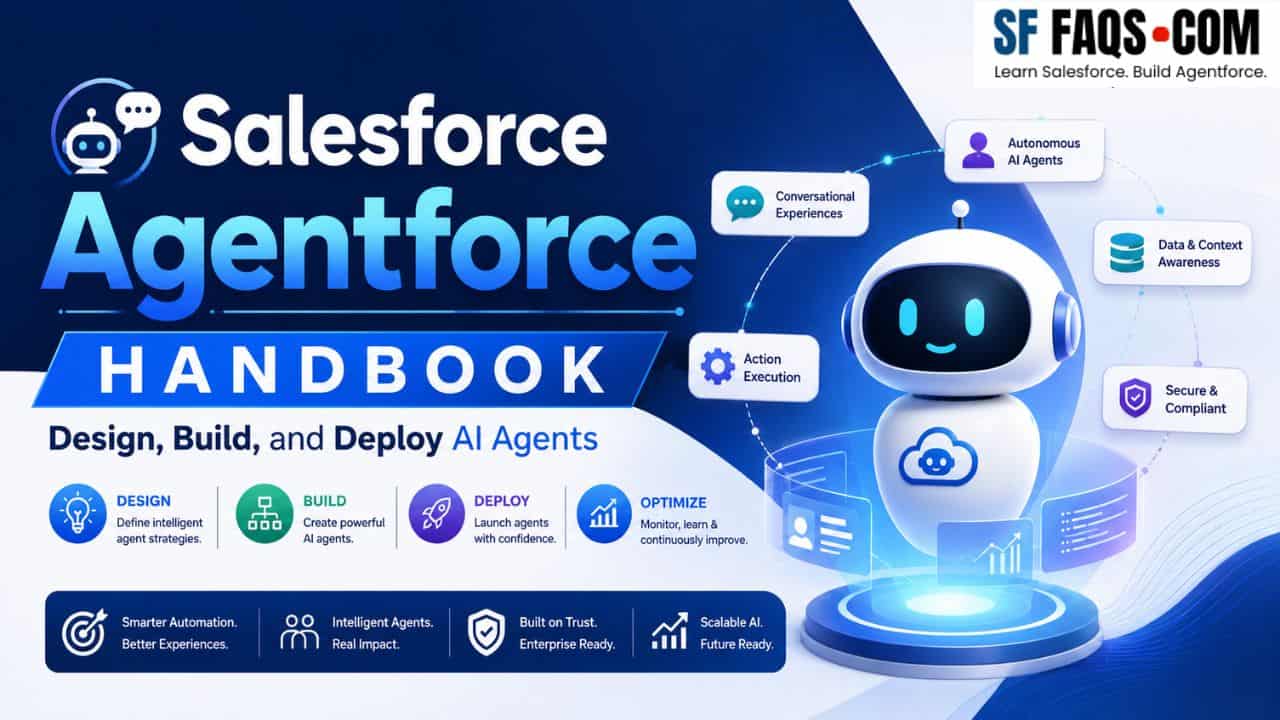
In this Salesforce Agentforce handbook, I have brought together all my Agentforce tutorials, patterns, and real‑world examples in one place so that you can learn how to design, build, and deploy AI agents in Salesforce for sales, service, and employee support.
Instead of jumping between random blog posts, you can use this page as your main guide. Start with Agentforce fundamentals, then go deeper into agents, prompts, Data Cloud, custom actions, Omni‑Channel, Slack, and integration with Salesforce Flow.
Who this Salesforce Agentforce Handbook is for
This handbook is for you if:
- You are a Salesforce Admin, Architect, or Developer who wants to build real AI agents using Agentforce.
- You want to understand when to use Agentforce vs traditional automation like Flow or Apex.
- You are planning or leading an Agentforce implementation and need patterns, best practices, and troubleshooting guidance.
You can follow this page from top to bottom as a learning path, or jump directly into the sections that match your current project.
What is Salesforce Agentforce, and why does it matter
Salesforce Agentforce is Salesforce’s digital labor platform that lets you build AI‑powered agents for sales, service, and employee use cases, connected deeply with your CRM data and automation.
With Agentforce, you can:
- Build agents that understand your Salesforce data and business rules.
- Use prompts, Data Cloud, and custom actions to make agents smart and safe.
- Integrate agents with channels like Slack, Omni‑Channel, and email.
If you want to move from basic generative AI experiments to production‑ready AI agents inside Salesforce, Agentforce is the platform you need to master.
Start Here: Agentforce Overview and Fundamentals
Begin with these posts to understand what Agentforce is, how it compares to Einstein Bots, and what the overall architecture looks like.
- Start Learning Agentforce Roadmap: A Practical Beginner Guide
- Salesforce Agentforce
- Agentforce 2.0 Digital Labor Platform in Salesforce
- Agentforce Vs Einstein Bots in Salesforce
- Real Business Problems Solve Agentforce
- Salesforce Agentforce Best Practices for Agents
- Best Practices for Implementing Agents in Salesforce Agentforce
These articles give you a solid foundation: why Agentforce exists, when to use it, and how to think about AI agents as part of your overall Salesforce architecture.
Agent Types and Core Agent Concepts
Next, understand the different Agentforce agent types and how they map to real‑world roles.
- Salesforce Agentforce Employee Service Agent
- Salesforce Action Agentforce Employee Agent
- Salesforce Agentforce Einstein Agent Agent
- Salesforce Agentforce Agent For Setup
- Create an AI Agent With Agentforce Script Builder in Salesforce
- Create an AI Service Agent with Agentforce Script in Salesforce
Use these posts to get comfortable with the idea of different agent personas (employee, service, setup, Einstein agents) and how they interact with your Salesforce org.
Get Started: Set up and Developer Foundations
Before you build production agents, you need a proper environment and developer foundations.
- Create Agentforce Enabled Scratch Orgs From Salesforce Developer Edition
- Salesforce Agentforce For Developers
- Agentforce For Developers in Salesforce
- Introduction to Model Builder in Salesforce Agentforce
These articles help you set up the right dev environment, enable Agentforce features, and understand how Model Builder fits into the overall AI stack.
Prompts, Prompt Builder, and Prompt Templates
Prompts are the brain of your agents. Start with the prompt builder and prompt templates to design consistent, reusable prompt logic.
- Prompts And Prompt Builders in Salesforce Agentforce
- Prompt Builder Template Salesforce Agentforce
- Build Sales Email Prompt Template in Salesforce Agentforce
- Agentforce Record Summary Prompt Template
- Field Generation Prompt Template in Salesforce Agentforce
- Assign a Prompt Template Action to Agentforce Agents
- Create a Custom Retriever in Salesforce Agentforce
- Assign Record Summary Prompt Template to AI Agent in Salesforce Agentforce
- Invoke Flows From Prompt Template in Salesforce Agentforce
With these templates and examples, you can build structured prompts for summaries, field generation, and sales emails that your agents can reuse.
Data Cloud, Data Libraries, and the Atlas Reasoning Engine
Agentforce relies heavily on structured data access and reasoning. Learn how to prepare data and use Agentforce’s reasoning tools.
- Set Up Data Cloud in Salesforce Agentforce
- Agentforce Data Cloud Library in Salesforce
- Agentforce Data Library in Salesforce
- Assign Data Library To Agentforce Agent
- Atlas Reasoning Engine in Salesforce Agentforce
These tutorials show you how to connect Agentforce to the right data sets, assign data libraries to agents, and leverage the Atlas reasoning engine for better responses.
Custom Actions, Apex, and External API Calls
Agents become powerful when they can take actions — create/update records, call external APIs, or execute Apex logic.
- Agent Custom Action in Salesforce Agentforce
- Create Assign Actions Agentforce Agents
- Assign Custom Actions Agents in Agentforce
- Custom Actions using Apex for Agentforce
- Salesforce Agentforce Action Call External Apis
- Agentforce Fetch External Api Data Action
- Salesforce Create Agentforce Employee Agent
- Update Case Status Using Agentforce AI Agent in Salesforce
- Building Blocks of Agents in Salesforce [Topic, Instructions, Actions]
Use these examples to design safe, reusable custom actions that connect agents to both Salesforce and external systems.
Agentforce with Salesforce Flow and Automation
Agentforce and Flow work very well together. You can call agents from Flow, or use Flow as a custom action for agents.
- Salesforce Agentforce Flow Custom Action Agent
- Create Custom Action using Flow for Agentforce in Salesforce
- Call Agentforce Agent Via Salesforce Flows
- Call Agentforce Prompt Template Salesforce Flow
- Agentforce Agent Action: HTTP Callout with Salesforce Flows
- Outbound Omni-Channel Flow in Salesforce Agentforce
These patterns help you embed Agentforce into existing Flow‑based automations so you can mix deterministic logic (Flow) with AI‑driven reasoning (Agentforce).
Agentforce for Sales, Service, and Employee Support
If you want to see how Agentforce maps to real business use cases, start with these:
- Agentforce For Sales Service Employee Support
- Configure Agentforce For Customer Service in Salesforce
- Salesforce Agentforce Employee Service Agent
- Agent For Admin in Salesforce Agentforce
- Add Branding to Agentforce Service Agent by Adding Logo, Color, and Font
- Agentforce Script AI Agent Custom Action to Close Cases
Use these tutorials as inspiration for designing your own sales, service, and internal‑support agents.
Agentforce with Omni‑Channel, Chat, and Slack
To bring agents into the channels where your users and customers are, you can integrate Agentforce with Omni‑Channel and Slack.
- Salesforce Agentforce Inbound Omnichannel Flow
- Deploy Agentforce Agent to Slack
- Deploy Agentforce Service Agent Slack
- Transfer Chat Agentforce Ai Human in Salesforce
- Agentforce Transfer Request From Ai To Human
- Create and Deploy Slack Agent From Salesforce to Slack
- Salesforce and Slack Integration | Features, Setup & Tips
These articles help you connect agents to real‑time channels and design smooth hand‑off experiences between AI and human agents.
Agentforce Vibes, LWC, and Advanced Developer Topics
If you are a developer, you can go deeper into vibes, Apex, and LWC integrations.
- Agentforce Vibes in Salesforce For Developers
- Apex Class Lwc Component With Agentforce Vibe
- Salesforce Agentforce For Developers
These posts are ideal when you want to embed agents inside custom UIs or use advanced developer features around actions and vibes.
Trust, Security, and Einstein Trust Layer
When working with AI agents, trust and security are critical. Use these posts to understand the guardrails Salesforce provides.
- Einstein Trust Layer in Salesforce Agentforce
- Salesforce Agentforce Best Practices for Agents
- Best Practices For Implementing Agents in Salesforce Agentforce
- Access Einstein Copilot in Salesforce (Step-by-Step Guide 2026)
These guidelines will help you design agents that respect data boundaries, privacy, and security standards.
Email, Auto‑replies, and AI‑assisted Communication
Agentforce is very powerful for automating email replies and communication flows.
- Auto Email Replies Agentforce Agents Salesforce
- Einstein Service Replies For Email in Salesforce Agentforce
Use these examples to see how Agentforce can draft, summarize, and manage email replies in a controlled way.
Training, Certification, and Learning Path
If you want a structured path to upskill on Agentforce and prepare for future certifications, start here:
- Salesforce Agentforce Training And Certification Resources
- Agentforce For Developers in Salesforce
- Agentforce For Sales Service Employee Support
- Agentforce training course
All Salesforce Agentforce tutorials
Below is a complete list of all Agentforce‑related tutorials on my site. Use this as a reference index or to quickly jump into a specific topic.